

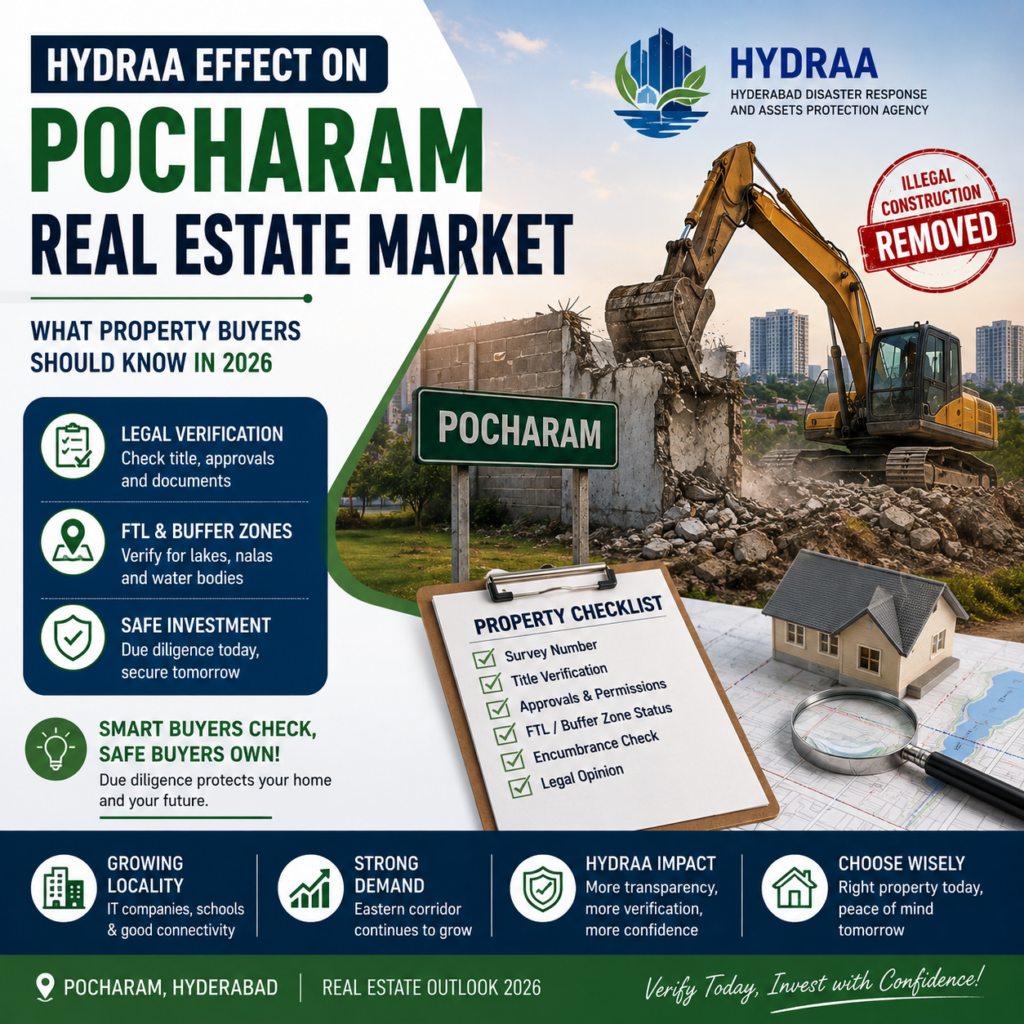
When people talk about HYDRAA and Hyderabad real estate, the first places that usually come to mind are the western parts of the city—Kokapet, Narsingi, Gachibowli, Kondapur and the Financial District. But there is another question that deserves attention: HYDRAA Effect on Pocharam Real Estate
What does HYDRAA mean for property buyers in Pocharam? Buyers Should Know.
This is not just a theoretical question anymore.
HYDRAA has already taken action in Pocharam. In October 2025, the agency removed an illegally constructed boundary wall in Bhavani Nagar, Pocharam, after complaints, inspections and hearings. The wall had blocked access to plots in an approved layout, according to reports.
Then, in January 2026, HYDRAA reclaimed 6.12 acres of government land in Kachavani Singaram village in Ghatkesar mandal. Officials said the land had been extended into an adjacent layout and that nearly 50 illegal plots had been identified within the encroached area.
For someone considering flats for sale in Pocharam, plots, villas or independent houses, these developments raise an obvious question:
Should HYDRAA make us more cautious about buying property in Pocharam?
My view is: yes, buyers should be more careful—but that does not mean they should avoid Pocharam.
In fact, the HYDRAA era may eventually make a well-documented property more valuable than a property that is merely cheap.
First, what exactly is HYDRAA doing?
HYDRAA stands for the Hyderabad Disaster Response and Assets Protection Agency.
Its work includes protecting public assets and addressing unauthorised occupation or construction involving areas such as lakes, water bodies, nalas, government land, parks and other public assets.
The government’s broader urban policy is also placing greater emphasis on restoring water bodies, removing encroachments and improving public infrastructure. In March 2026, the Telangana government highlighted HYDRAA’s restoration of Nalla Cheruvu in Kukatpally and linked lake restoration and removal of nala encroachments with Hyderabad’s future urban development.
That matters to real estate because Hyderabad has grown very quickly.
And when a city grows quickly, the question is not only:
“Where can we build?”
It is also:
“Where should we not build?”
That distinction is becoming much more important.
HYDRAA EFFECT ON Pocharam REAL ESTATE?
Pocharam is part of Hyderabad’s eastern growth corridor.
It has residential development, employment centres, educational institutions and highway connectivity. The broader Pocharam-Ghatkesar belt is also seeing continued interest from buyers looking for comparatively value-oriented housing.
But there is another reason HYDRAA matters here:
The wider Ghatkesar area has already seen HYDRAA action.
The January 2026 Kachavani Singaram case is a good example. Officials said government land had been incorporated into a private layout and sold as residential plots. HYDRAA fenced the land after verification by the Survey and Land Records department.
This doesn’t mean every plot or apartment in Pocharam or Ghatkesar has a problem.
It means buyers should not assume that a developed-looking neighbourhood automatically means every parcel of land has a clean legal history.
What happened in Pocharam?
This is probably the most important local example for this article.
In Bhavani Nagar, Pocharam, HYDRAA acted against a boundary wall that officials found to be illegally constructed.
According to the reported case, the wall had blocked access to 88 plots within a 27-acre approved layout. Following complaints from the Bhavani Nagar Welfare Association, inspections and hearings were conducted before the wall was removed.
There is an interesting lesson here.
The HYDRAA story is not always about demolishing an apartment building.
Sometimes the issue can be something much simpler:
A boundary wall.
A blocked road.
An encroached open space.
A government parcel.
A lake boundary.
That is why property due diligence needs to look beyond the building itself.
Does HYDRAA mean Pocharam is a risky real-estate market?
Not necessarily.
This is where buyers need to avoid two extremes.
One extreme is:
“HYDRAA is active, so don’t buy anything in Pocharam.”
The other is:
“The builder has approvals, so there is nothing to worry about.”
Both are too simplistic.
The sensible approach is somewhere in the middle.
Buy the property after checking the property.
Pocharam itself is not a single piece of land.
Every apartment project, plot, villa and independent house has its own survey numbers, title history, permissions and surrounding conditions.
The biggest change HYDRAA has brought: buyers are asking different questions
Earlier, a property buyer might mainly ask:
What is the price per sq.ft.?
How many amenities are there?
How far is the ORR?
What is the builder offering?
Now another set of questions is becoming equally important:
What is the survey number?
Who owns the land?
Is there any government land nearby?
Is the property close to a lake or nala?
What is the notified FTL?
Does any part of the layout fall within a restricted area?
Are the roads and open spaces legally part of the approved layout?
That is probably the biggest long-term HYDRAA effect on the property market.
It is changing the questions buyers ask before paying money.
What about FTL and buffer zones?
This is particularly important.
FTL means Full Tank Level.
In simple terms, it identifies the notified water-spread boundary of a lake or tank.
Around notified water bodies, applicable buffer restrictions can also affect development.
HMDA’s lake database provides information including lake FTL, cadastral information and survey numbers affecting FTL and buffer zones.
So if you are buying a property near a lake, tank, kunta or nala, don’t depend on statements such as:
“The lake is very far.”
or
“There are already many houses here.”
or
“The property is registered, so there is no issue.”
Instead, check the actual survey number and official records.
That is a much safer approach.
Does registration mean the property is completely safe?
No buyer should assume that.
Registration is an important part of a property transaction, but it is not a substitute for complete due diligence.
The same principle applies to an apartment.
A project can have a RERA registration and still deserve a detailed examination of:
- Land title
- Survey numbers
- Development permissions
- Building permissions
- Encumbrances
- Applicable environmental restrictions
- FTL/buffer issues, where relevant
- Completion and occupancy documentation
The bigger lesson is simple:
Never judge the safety of a property from one document alone.
How is HYDRAA affecting Hyderabad’s overall real estate market?
To understand Pocharam, it helps to look at the larger Hyderabad market.
And the interesting thing is that HYDRAA has not brought Hyderabad’s real-estate market to a standstill.
JLL’s Q1 2026 Hyderabad residential report says housing sales remained resilient, with more than 7,160 apartment units sold in the western suburbs and the eastern suburbs also among the leading sales submarkets. Overall new residential launches reached 10,665 units in Q1 2026. JLL also reported that capital values increased 1.9% quarter-on-quarter, although it noted slower movement in higher-priced segments and continued inventory overhang.
That tells us something important.
The Hyderabad market is still active.
But buyers are becoming more selective.
And HYDRAA is one reason legal and environmental clarity has become a more visible part of that decision.
Is HYDRAA causing property prices to fall across Hyderabad?
There is no good basis to make such a blanket statement.
Hyderabad property prices are influenced by many factors:
- IT and other employment
- Infrastructure
- Land prices
- Construction costs
- Interest rates
- New project supply
- Buyer demand
- Local connectivity
- Rental demand
- Investor sentiment
- Government policies
HYDRAA is one factor among these.
Its more visible impact is on risk perception.
A buyer may now think twice before purchasing a property simply because it is ₹500 or ₹1,000 cheaper per sq.ft.
The question becomes:
“Why is it cheaper?”
That is a healthy question.
A cheaper property is not always a cheaper property
Consider two plots.
Plot A
₹40,000 per sq. yd.
Clear title, approved layout, proper road access and clean documentation.
Plot B
₹30,000 per sq. yd.
But there are unanswered questions about land boundaries and government records.
At first glance, Plot B looks like the bargain.
But what happens when you want to:
- Construct a house?
- Get a bank loan?
- Resell the property?
- Obtain permissions?
- Transfer the title?
The ₹10,000 difference may suddenly look very small.
This is why HYDRAA could actually create a quality premium in Hyderabad real estate.
Properties with strong documentation may command greater confidence than properties where buyers have unresolved doubts.
What could this mean specifically for Pocharam property prices?
This is where we need to be realistic.
I would not say:
“HYDRAA will reduce Pocharam prices.”
There isn’t enough evidence to support that statement.
Instead, I see the market potentially becoming more segmented.
Properties with clean documentation
These may continue attracting end-users who are looking for long-term homes.
Properties with unclear land status
These could face greater negotiation pressure and slower buyer decisions.
Approved, established communities
These may benefit from buyers who prefer lower perceived risk.
Individual plots
Buyers may become more demanding about title, layout approval and survey details.
This is especially relevant because Pocharam has a mix of apartments, plotted developments, independent houses and other residential properties.
Is Pocharam still attractive for homebuyers?
Yes—but for the right reasons.
Pocharam’s attraction does not depend entirely on future speculation.
The area already has an established residential base and employment presence, including the Infosys campus and Mindspace Pocharam IT Park/SEZ.
The wider eastern corridor also has education and employment infrastructure.
Market data published for Q2 2026 places the eastern Pocharam-Ghatkesar corridor among Hyderabad’s more affordable organised residential markets, with asking prices reported around ₹4,800–₹6,500 per sq.ft. in that dataset.
That makes the locality interesting to buyers who want to enter the Hyderabad market without paying western-suburb prices.
But the word “selectively” is important.
Don’t buy simply because Pocharam is cheaper.
Buy a good property in Pocharam.
There is a difference.
What should someone looking for flats for sale in Pocharam check?
If I were buying an apartment in Pocharam in 2026, my checklist would be different from a few years ago.
I would ask the developer for:
1. Exact survey numbers
Don’t settle for just the project name.
2. Land documents
Understand who owns the land and how the title has evolved.
3. Project approvals
Verify the relevant planning and building permissions.
4. RERA details
Where applicable, verify the project’s RERA registration and disclosures.
5. Nearby water bodies
Find out whether a lake, kunta, nala or major stormwater channel is nearby.
6. FTL and buffer information
Where relevant, verify the property’s relationship to officially notified boundaries.
7. Road and open-space status
Make sure the roads and open spaces shown in the layout are actually part of the approved plan.
8. Independent legal opinion
For a major purchase, get the documents reviewed by an independent property lawyer.
That last point is particularly important.
The lawyer should be working for you, not simply relying on the documents supplied by the seller.
What about plots in Pocharam?
Plot buyers should arguably be even more careful.
With an apartment, you are buying into a larger project with multiple approvals and documentation.
With an individual plot, the land itself is the product.
So verify:
Survey number
Sub-division
Title
Encumbrance
Layout approval
Land use
Road access
Government land status
FTL/buffer status if applicable
Physical boundaries
Never buy a plot simply because someone says:
“This is an approved venture.”
Ask to see the approval.
Then independently verify it.
What about independent houses and villas?
The same principle applies.
An attractive independent house can hide a very ordinary land problem.
A buyer should check:
Is the house legally constructed?
What is the land title?
Are there any deviations?
What is the actual plot boundary?
Is the road access documented?
Are there any issues with nearby government land, drains or water bodies?
For villas, also check whether the individual villa and the overall community have the necessary approvals and documentation.
Could HYDRAA actually be good for genuine property buyers?
This is the part that is often missed in the debate.
At first, stricter enforcement can make buyers nervous.
But over time, it can also improve the market.
Imagine a future Hyderabad where buyers increasingly ask for:
Clear title
Verified survey numbers
Approved layouts
Proper building permissions
Environmental compliance
Transparent documentation
That is not necessarily bad for real estate.
It can make the market healthier.
The Telangana government has publicly connected HYDRAA’s work with lake restoration, removal of encroachments and better urban infrastructure. In March 2026, the government highlighted the restoration of Nalla Cheruvu and proposed surrounding public amenities and open spaces.
If water bodies and public land are better protected, the long-term urban environment can also improve.
But should buyers be worried about every HYDRAA headline?
No.
This is another important lesson.
News reports about demolitions can create fear, but every property has its own facts.
There have also been legal challenges to HYDRAA’s actions in individual cases. For example, the Telangana High Court has intervened in disputes involving HYDRAA action, demonstrating that specific cases can involve questions of procedure, ownership and legal rights.
Therefore, buyers should avoid both:
blind confidence
and
unnecessary panic.
The right approach is verification.
What does this mean for Pocharam in the next few years?
Pocharam’s real-estate story is still bigger than HYDRAA.
The locality has:
- Residential development
- IT employment
- Educational institutions in the wider corridor
- Highway connectivity
- Growing social infrastructure
- A comparatively accessible entry point than several western Hyderabad markets
Those fundamentals will continue to matter.
HYDRAA adds another layer:
legal and environmental due diligence.
So I don’t think the future question for Pocharam is:
“Will HYDRAA stop development?”
A better question is:
“Which developments will stand up to stronger scrutiny?”
That distinction could become increasingly important.
Pocharam Real Estate: What Buyers Should Look For in 2026
If you are considering buying property in Pocharam, I would divide the market into three simple categories.
Green: Strong documentation
Clear title, verified survey numbers, appropriate approvals and no known land-status concerns.
These are the properties worth serious consideration.
Yellow: Need further verification
Some documents are available, but there are unanswered questions about boundaries, permissions or surrounding land.
Don’t rush. Get the documents checked.
Red: Serious unresolved concerns
Government land disputes, FTL concerns, unauthorised construction or major title issues.
A low price should not tempt you into ignoring these risks.
So, should you buy property in Pocharam in 2026?
My answer would be:
Don’t avoid Pocharam because of HYDRAA.
But also:
Don’t buy in Pocharam without checking the property carefully.
The locality still has genuine residential and employment fundamentals.
At the same time, HYDRAA’s actions in Pocharam and the wider Ghatkesar area show that land-status verification is not something buyers should treat casually.
For a family buying a flat, this means checking the project.
For a plot buyer, it means checking the land.
For an independent-house buyer, it means checking both the land and the building.
And for an investor, it means understanding what you are actually buying—not just what the brochure promises.
The bigger HYDRAA lesson for Hyderabad real estate
HYDRAA has not made Hyderabad real estate disappear.
Hyderabad continues to see residential demand, new supply and investment interest. JLL’s 2026 market assessment shows that housing sales remain active, although the market is also dealing with premium-segment sluggishness and inventory overhang.
What HYDRAA has done is make one thing much more visible:
A property’s value is not only its location and price.
There is also the value of certainty.
A legally clear property may not always be the cheapest.
But buyers may increasingly prefer certainty over a bargain.
And that could be one of the most important long-term changes HYDRAA brings to Hyderabad’s real-estate market.
Final Thoughts: HYDRAA EFFECT ON Pocharam REAL ESTATE
HYDRAA Is Changing the Way Hyderabad Buys Property
A few years ago, a buyer could spend more time discussing:
“Which floor?”
“East facing or west facing?”
“How much discount?”
Today, another conversation is becoming equally important:
“Show me the documents.”
For Pocharam, that is not necessarily a negative development.
It could actually help separate genuine projects from questionable ones.
The locality still has reasons to attract families, professionals and long-term buyers.
But the smart buyer in 2026 will not simply ask:
“Is Pocharam a good location?”
They will ask:
“Is this particular property in Pocharam a good property?”
That is a much better question.
And perhaps that is the real HYDRAA effect on Pocharam real estate.
Not necessarily a collapse in prices.
Not necessarily a boom.
But a market where documentation, land status and buyer confidence matter more than they used to.
If you are considering property in Pocharam
Before paying an advance, verify the survey number, title, layout/building approvals, RERA details where applicable, and FTL/buffer status where relevant. HMDA’s lake database provides official information on notified lakes, FTL and survey numbers affecting FTL and buffer zones.
And if you are comparing flats for sale in Pocharam, don’t compare only the price per square foot.
Compare the property, paperwork, location and risk together.